

The difference between a good mountain flight and a stressful one usually comes down to logistics. An everest base camp helicopter tour is not just a scenic ride - it is a weather-sensitive, weight-managed, altitude-aware operation that needs to run on time, with the right aircraft, permits, briefing, and contingency planning in place.
For travelers coming to Nepal on a fixed holiday window, this trip solves a real problem. You get close access to the Everest region in a single day without committing to a multi-day trek, and you still experience glacier terrain, high Himalayan views, and the drama of landing in the Khumbu. That is why this tour appeals not only to luxury travelers, but also to families, photographers, business travelers, and trekkers who want a helicopter return option built into a wider itinerary.
What an Everest base camp helicopter tour actually includes
In most cases, the day starts early from Kathmandu, with hotel pickup and transfer to the domestic helicopter departure point. The early start is operationally important, not cosmetic. Morning conditions are usually more stable, visibility is better, and mountain flights are more likely to operate on schedule before cloud build-up and afternoon wind complicate the route.
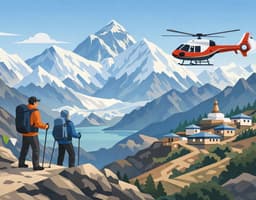
The standard routing heads east from Kathmandu toward the Everest region, typically with a fuel or operational stop around Lukla depending on the aircraft plan and passenger load. From there, the helicopter continues deeper into the Khumbu, flying past major landmarks such as Namche, Tengboche, Pheriche, and the glacier systems near Everest Base Camp and Kala Patthar.
A key point many travelers miss is that not every flight lands directly at Everest Base Camp itself. In practice, landings are often managed around safe high-altitude points such as Kala Patthar or nearby designated zones, and these are subject to current aviation rules, weather, ground conditions, and aircraft performance. If you see an itinerary marketed as an Everest Base Camp heli tour, read it as an Everest region helicopter experience with high-mountain landing components, not a guaranteed touchdown on the exact trekking campsite every day of the year.
Most premium itineraries also include a breakfast stop at a high-end Everest-view hotel in the region, commonly around Syangboche. That part matters more than it may seem. It gives guests time outside the aircraft at a safer elevation, offers wide mountain views without the same altitude pressure as a very high landing, and makes the tour feel like a complete product rather than a quick flyover.
Why travelers choose this trip over trekking
The first reason is time. A classic Everest Base Camp trek takes around 12 to 14 days for most itineraries, not counting international travel days. A helicopter tour compresses the access dramatically. If you are combining Nepal with India, Bhutan, a safari extension, or a short business trip, that time efficiency changes what is possible.
The second reason is physical demand. Trekking to Everest Base Camp is rewarding, but it requires sustained walking at altitude, adaptation days, and tolerance for basic mountain accommodation. A helicopter tour gives older travelers, families with limited time, and guests who do not want a full trekking program a way to experience the Everest region without the same endurance requirement.
The third reason is trip design flexibility. Some travelers want the mountain experience but not the round-trip trek. In that case, a luxury trek with helicopter return often makes more sense than a standalone flight. Others know they only have one free day in Kathmandu and want the highest-value aerial experience available. The right choice depends on schedule, budget, and how much time you want on the ground versus in the air.
Weather, altitude, and why schedules can change
This is where good operators separate themselves from resellers. An Everest flight product looks simple on a booking page, but actual execution depends on mountain weather windows, cloud movement, visibility on the Lukla sector, payload restrictions, and safe landing calculations.
Even in strong trekking seasons, flights can be delayed, rerouted, or pushed to the next available morning. That is normal in Himalayan aviation. It does not always indicate poor organization. Often, it shows the opposite - that the operator and crew are making conservative decisions instead of forcing a marginal departure.
Altitude is the other major operational factor. Helicopters can reach very high terrain, but passenger time at extreme elevation is intentionally limited. The reason is straightforward: reduced oxygen, cold exposure, and aircraft performance all matter more as altitude increases. Expect short high-altitude stops rather than extended roaming time.
If you have a heart or respiratory condition, or if you are sensitive to altitude, this should be discussed before booking. The tour remains feasible for many travelers, but practical screening matters. A responsible operator will brief you clearly, not simply sell the seat.
Shared tour or private charter
This is usually the main pricing decision. A shared everest base camp helicopter tour spreads the aircraft cost across multiple passengers, making the trip far more accessible. It works well for couples, solo travelers, and small groups who are comfortable with a scheduled departure and a standardized route.
A private charter gives you more control over pacing, pickup coordination, and the overall experience. It is often the better fit for families, photographers with specific goals, VIP travelers, or guests connecting with a high-end lodge stay or a custom Nepal itinerary. The trade-off is obvious - the price rises substantially, and weather disruption still applies whether you are on a shared or private flight.
For some groups, there is also a middle ground. If four or five travelers are moving together, a private charter may not be as far from per-person shared pricing as people first assume. That is why comparing only the headline price can be misleading.
What to check before you book
Not all helicopter products are built to the same standard. The route may sound similar across websites, but the support behind it can be very different.
Start with the operator's role. Are they actually organizing the flight and ground handling in Nepal, or are they passing your inquiry through layers of intermediaries? For mountain operations, direct local control is a serious advantage. It usually means faster updates, better troubleshooting, clearer passenger coordination, and more realistic pre-departure communication.
Next, check what is included. Airport transfers, permits, domestic taxes, breakfast stop charges, national park fees, and oxygen availability should not be vague. If the product description is thin, expect friction later.
You should also look for signs of operational discipline. Certification references, legal documentation, QHSE policy, fleet transparency, and clear terms are not just corporate formalities. They indicate that the company treats remote travel as an organized service, not an informal excursion. That matters a great deal in the Everest region.
What to wear and carry on the day
Even on a short trip, mountain conditions can shift quickly. Dress in layers and assume a large temperature difference between Kathmandu and the landing zone. A warm jacket, gloves, sunglasses, and good shoes are more useful than bulky travel fashion.
Carry only what you need. Space and weight are controlled on helicopter flights, and soft bags are easier to manage than hard luggage. Keep your passport copy, personal medication, phone, and camera accessible. If you are bringing professional camera gear, tell the operator in advance so weight planning stays accurate.
Hydration helps, but this is not the day to overpack snacks and extra items you will never use. Efficient loading and balance are part of safe mountain flying.
Is the tour worth it?
That depends on what you want from Everest. If your goal is the emotional arc of walking village to village, earning each altitude gain, and arriving at base camp on foot, no helicopter experience replaces that. The trek is still the right product.
But if your goal is to see the Everest region clearly, maximize a short Nepal schedule, travel in greater comfort, or add a premium aerial day to a broader itinerary, then this flight is one of the most efficient mountain experiences available. For the right traveler, it is not a shortcut in a negative sense. It is a different format built around access, time, and controlled logistics.
Shepherd Holidays approaches this kind of product the way it should be handled in Nepal - as a tightly coordinated mountain operation with clear routing, realistic expectations, and on-ground support from inquiry to final transfer. That is what turns a high-altitude flight from a hopeful booking into a workable plan.
If you are considering an Everest helicopter day, build one extra buffer day into your Nepal trip, ask precise questions before you confirm, and choose the operator that gives you the clearest answers. The Himalayas reward good planning just as much as good weather.