

If you’ve looked at an Everest helicopter day trip and seen two quotes that are thousands of dollars apart for what sounds like the same flight, you’re not imagining things. Most “EBC heli tour” pricing isn’t a single fixed tariff - it’s a stack of operational variables: group size, landing plan, season, aircraft availability, and even how many times the pilot needs to reposition to manage weight at altitude.
This guide breaks down the Everest Base Camp helicopter tour cost in practical terms so you can compare offers correctly and budget without surprises.
Everest base camp helicopter tour cost: typical ranges
For most travelers, the price falls into two common purchase styles: a per-seat share in a group, or a private charter for your party.
A shared per-seat option is typically the most cost-efficient. In normal operating windows, you’ll often see ranges around USD 950 to 1,500 per person for a shared helicopter tour to the Everest region (with the usual landings at Lukla and the Everest View Hotel area, and a flyover toward Everest Base Camp/Khumbu Glacier depending on conditions). The final number depends heavily on how the seats are filled and whether the day’s routing requires extra repositioning.
A private charter generally lands higher because you are buying the whole aircraft, not just a seat. For a standard 5-seat helicopter (typical allocation is 4 passengers plus pilot, sometimes 5 passengers depending on weight and conditions), private charter pricing commonly sits around USD 3,800 to 7,500+ per flight for a Kathmandu round-trip Everest heli program. If you’re a group of four, that can still work out competitively against peak-season shared seating, but only when the inclusions are comparable.
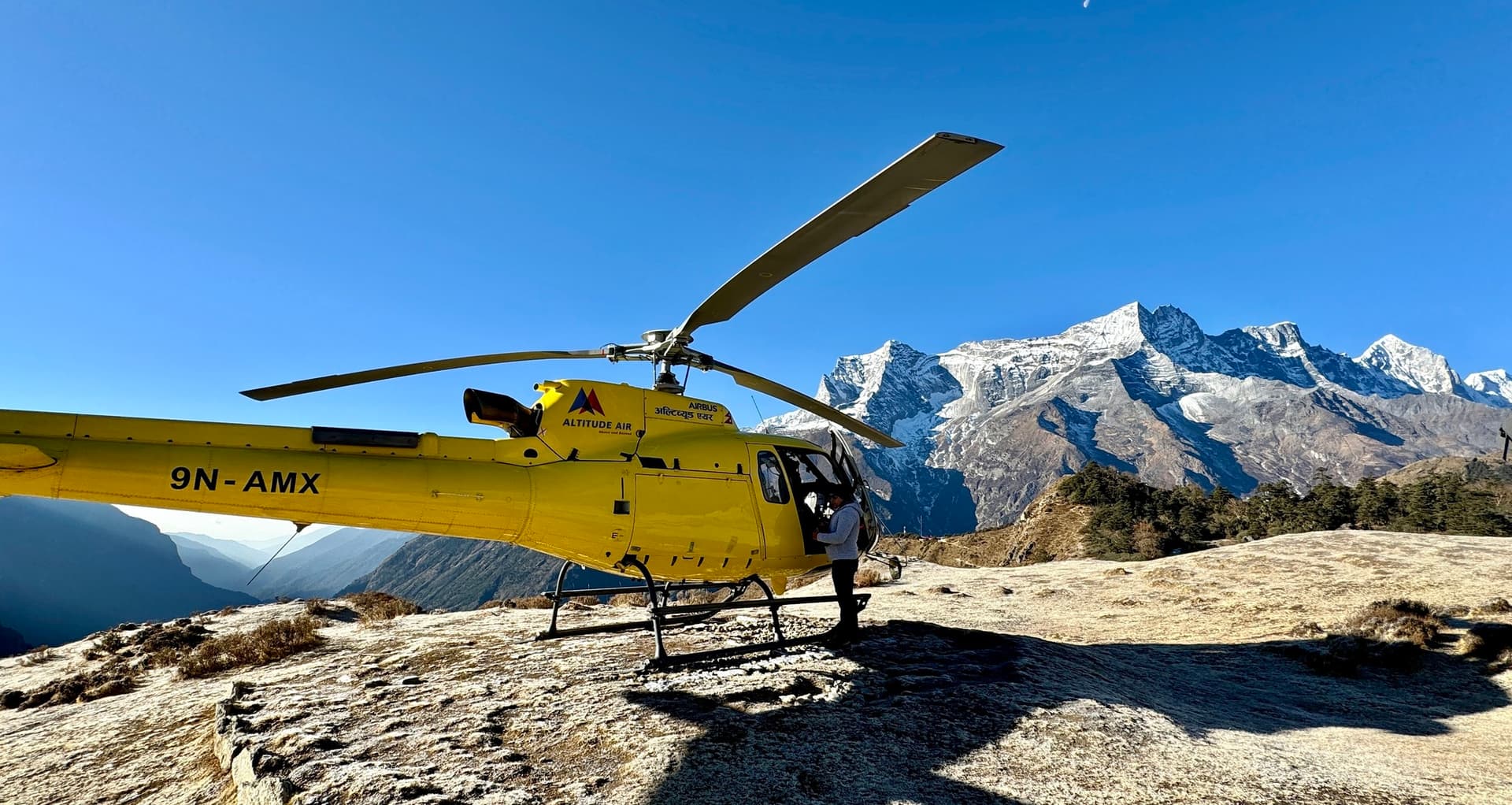
One important clarification: many itineraries marketed as “Everest Base Camp helicopter tour” do not land at actual Everest Base Camp. EBC itself is not a standard year-round heli landing point due to terrain, congestion in peak seasons, and safety constraints. Many day tours include a flyover of the EBC area/Khumbu Glacier and then a controlled landing at Kala Patthar area is generally not standard for routine landings, while Syangboche/Everest View Hotel is the common breakfast stop. Price comparisons only make sense when the landing plan is identical.
What’s usually included - and what quietly isn’t
Two packages can be priced similarly and still deliver different real value. When you request a quote, ask for the inclusions in writing.
Most properly structured costs include the helicopter flight (Kathmandu-Lukla-Everest region-Kathmandu), the pilot, and required aviation charges. Many also include airport transfers within Kathmandu, basic passenger handling, and any required coordination at Lukla.
What may not be included is where people get surprised. Breakfast at Everest View Hotel is sometimes included, sometimes charged separately. National park or local area fees may be embedded or billed as pass-through. If weather causes a partial operation - for example Kathmandu to Lukla and back - the refund logic varies by operator, and you should understand that before you pay.
If oxygen is mentioned, read the wording carefully. Carrying an emergency oxygen bottle is a safety provision some operators include as standard, but it is not the same as a medically staffed flight. A “medical-grade setup” with additional gear and clinical oversight is a different product and price point.
The cost drivers that actually change the price
Helicopter pricing in the Everest region is not arbitrary. Here’s what typically moves the needle.

Group size and weight planning
At high altitude, weight matters. A helicopter that can carry 5 passengers at lower elevation may need to limit passengers or do a shuttle/reposition near the Everest region to stay within safe performance margins. That affects price because extra legs burn time and fuel.
If your group is 2 travelers, your per-person shared cost can be lower - but only if the operator can match you with others on the same date and routing. If you need a guaranteed departure time with no dependence on other passengers, you’re moving toward a private charter structure.
Season and demand (and why “shoulder season” helps)
Peak windows - especially March to May and October to November - compress demand into a small number of flyable mornings. When aircraft are committed to rescue standby, trekking support, and premium sightseeing, charter rates rise. In shoulder months, you may find better value, but you need more flexibility for weather.
Landing plan and time on the ground
A simple routing with one technical stop at Lukla and one breakfast stop at Syangboche/Everest View Hotel is different from a multi-landing “premium” program. More landings mean more time, higher exposure to weather changes, and more operational coordination.
If an itinerary promises a specific landing viewpoint, confirm it’s realistic for that season and day’s conditions. Some “extra landing” promises are aspirational and become “if permitted” on the day.
Aircraft availability and repositioning
Helicopters move around Nepal based on rescue calls, charter demands, and maintenance schedules. If an aircraft must reposition to Kathmandu the evening before or after, that can affect the quote - especially for a private charter with tight timing.
A realistic way to compare quotes
To compare pricing fairly, get clarity on five items.
First, confirm whether it is shared seat or private charter, and how many paying passengers are assumed. Second, ask for the exact routing and planned landings. Third, ask whether breakfast and permits/fees are included. Fourth, confirm the weather policy: what happens if you fly partially, what is refundable, and what is rescheduled. Fifth, confirm the pickup/drop plan in Kathmandu and whether it’s private vehicle or shared transfer.
If a quote is significantly cheaper than the market range, it is usually because one of those items is missing, or because the operation is relying on last-minute seat filling with no firm departure guarantee.
Hidden costs to plan for (and how to avoid them)
Most “hidden costs” are avoidable if you lock the scope up front. The most common add-ons are breakfast, park/local fees, private transfers, and last-minute date changes.
Date changes matter because flights run on a narrow weather window. If your schedule has only one morning available in Kathmandu, you’re taking on risk. If you can hold two or three mornings, you reduce the chance of paying for hotel extensions or missing an onward flight.
Another cost travelers don’t anticipate is paying more for “exclusive” timing. Early departures are popular because visibility is best in the morning. If you insist on a specific slot, you may effectively be buying priority - which is fine, but treat it as part of the cost.
Weather, safety, and why cheaper isn’t always cheaper
The Everest region is operationally demanding. Morning conditions can look clear in Kathmandu and still be closed in Lukla, or vice versa. Any responsible operator will prioritize safe routing, legal flight limitations, and conservative go/no-go decisions.
From a cost perspective, that means you should value clear policies and disciplined operations as much as the headline rate. The cheapest quote becomes expensive if you lose a day to confusion over refunds, unclear rescheduling, or a plan that was never realistic for the season.
If you’re comparing operators, ask practical questions: Who is your on-ground point of contact at the airport? Do they provide written trip terms? Do they have documented safety and compliance standards? These are not marketing extras in Nepal - they are what keeps the day organized when the weather changes at 6:30 a.m.
Sample budgets by traveler type
If you’re traveling solo and you’re flexible on date, a shared seat is usually the best-value way to experience the Everest region by air. Budget around the mid-range and keep a buffer for a second attempt if weather cancels.
If you’re a couple with limited time, you may prefer a shared seat if it’s confirmed, but many couples choose a private charter to control timing and reduce uncertainty. The per-person cost can look higher, but the time efficiency can be worth it if you have fixed international flights.
If you’re a group of 3 to 5, private charter often becomes the cleanest solution. You’re spreading the aircraft cost across your party, and you’re not waiting for other seats to sell. Just make sure the operator is honest about weight planning and doesn’t promise passenger counts that become impossible at altitude.
Booking checklist that protects your wallet
Before you pay a deposit, ask for a written confirmation covering the route, landings, inclusions, and refund/reschedule terms. Confirm the departure airport (domestic terminal in Kathmandu), pickup time, and what ID you need on the day.
Also ask how they handle the breakfast stop. If breakfast is included, confirm whether it’s a fixed set menu or up to a capped amount. If it’s excluded, plan to carry a card or cash and budget accordingly.
If you want an operator that runs end-to-end logistics in Nepal and can coordinate the heli day alongside trekking, city tours, or a helicopter return from a trek, Shepherd Holidays (https://www.shepherdholidays.com/) structures these programs as packaged itineraries with on-ground coordination and clear operating terms.
A closing thought to plan the day right
Treat the Everest helicopter tour like a high-altitude operation, not a casual scenic flight: keep your morning flexible, compare offers based on routing and inclusions (not just the headline number), and pay for the level of certainty your schedule actually needs.